WE TURN HUMAN DATA INTO SYNTHETIC SOCIETIES TO TEST DECISIONS BEFORE EXECUTION.
Before you decide, simulate.
A BEHAVIORAL SIMULATION METHOD FOR STRATEGIC DECISION-MAKING.
A BEHAVIORAL SIMULATION AND INFERENCE LAB.
WELCOME TO THE AGE OF BEHAVIORAL SIMULATION.
GRANOVETTER TURNS CULTURAL, HUMAN AND CONTEXTUAL DATA INTO SYNTHETIC ORGANIZATIONAL SOCIETIES — POPULATED BY OUR SYNTHETIC AGENTS — BUILT TO TEST HOW REAL GROUPS REACT TO DECISIONS, CRISES, CHANGES AND STRATEGIC TENSIONS. WE DO NOT SIMULATE ISOLATED INDIVIDUALS. WE SIMULATE HUMAN SYSTEMS IN INTERACTION.
Every decision sets off reactions in a human system before it becomes a result.
Between intention and execution there are people. There is behavior.
Granovetter simulates those behaviors to anticipate outcomes, showing which scenarios are most likely to deliver the best return and which risks could compromise time, money and trust.
Simulate critical scenarios before a decision costs too much.
Granovetter lowers the cost of deciding wrong.
We created the grano.protocol, a behavioral simulation method built on artificial intelligence and applied science to turn strategic decisions into testable scenarios.
Simulating behavior is only the means. The end is showing which paths produce the best outcome before the decision burns time, money and trust.
Decision risk
Which path is likely to work best before you implement it.
Buy-in risk
Who is likely to buy in, resist, distort or ignore the decision.
Execution risk
What could compromise productivity, focus, collaboration and speed.
Cultural risk
Whether the decision strengthens or weakens trust, climate, belonging and openness to change.
Reputational risk
Noise, cynicism, parallel narratives and erosion of leadership.
Human behavior is not random. It is complex, but inferable.
Humans follow patterns. Groups converge, resist, imitate, polarize and reorganize.
Inside an organization, collective behavior is not the sum of individual opinions. It is an emergent dynamic, shaped by culture, context, ambition, trust, fear and social pressure.
That is why companies can be simulated: to anticipate patterns, tensions and risks before they reach execution.
Average overlap between synthetic simulation and traditional research.
Direct comparisons validating the accuracy of synthetic inference.
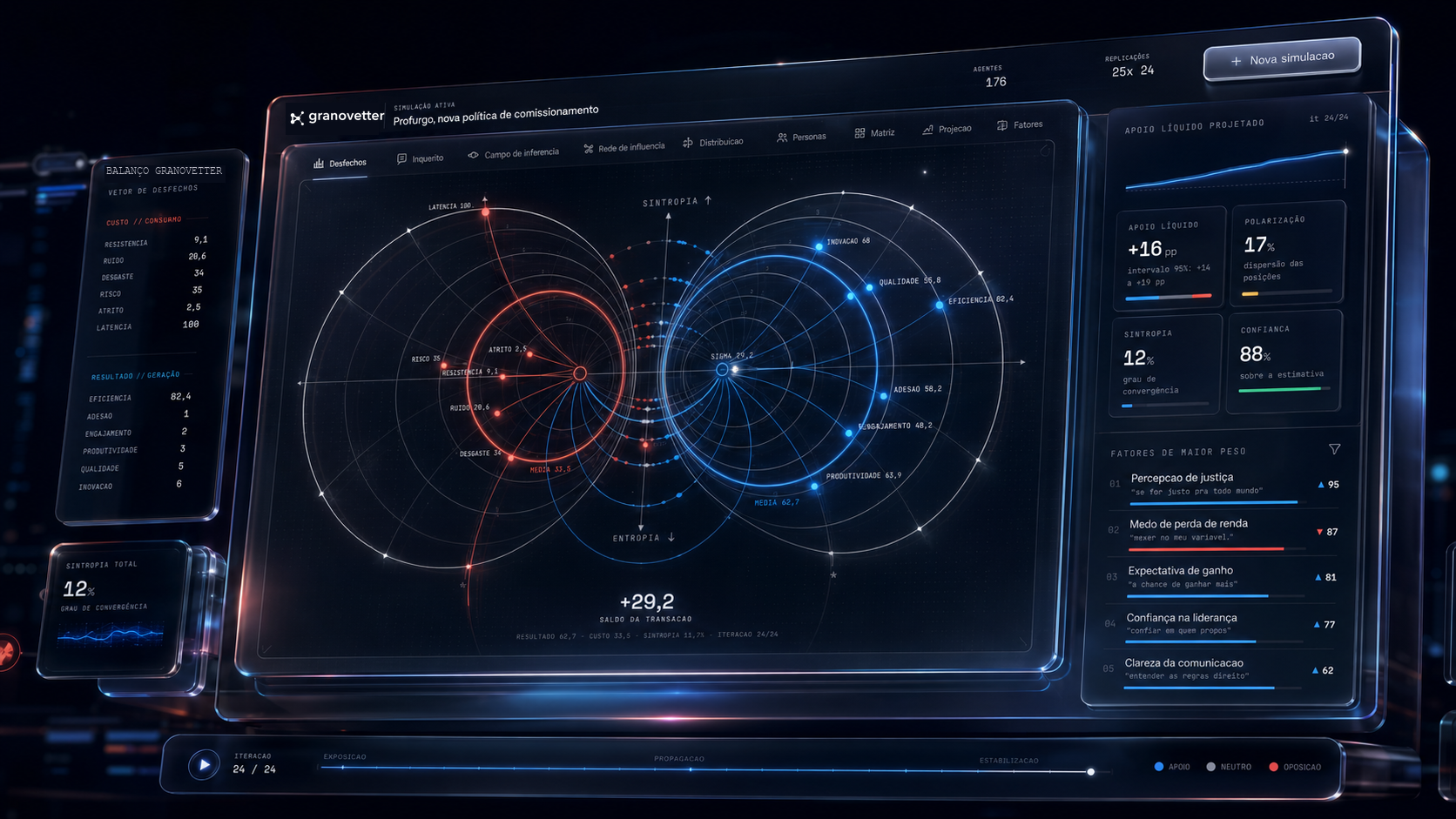
AI Behavioral Science is the convergence of behavioral science, complex systems and generative artificial intelligence.
My name is Dheiver Santos, PhD.
I am the founder of Granovetter.
Machine learning engineer and AI researcher, with a PhD in Chemical Engineering with an emphasis on Artificial Intelligence (UFBA/UFRJ) and postdoctoral research at UNICAMP/UNIT (CNPq) and UFAL (FUNDEPES). My career was shaped in senior industry roles, as Senior Staff Machine Learning Engineer at SX Negócios and Senior Scientist at Grupo Boticário, and in the classroom, teaching AI, distributed systems and data science at UPE and Estácio.
I created Mangaba.AI, an open-source framework for teams of autonomous AI agents, and founded Cognai, a healthtech applying AI to cardiology.
My academic work spans machine learning and neuro-symbolic computing: 200+ papers, 550+ citations, h-index 12, an INPI patent and 10 AI products delivered in real clinical and operational workflows.

The grano.protocol turns strategic decisions into behavioral simulations.
From decision to collective behavior
grano.protocol
Published by
Every simulation begins by building synthetic agents based on real profiles from the organization: culture, context, demographics, territory, history and behavioral tendencies.
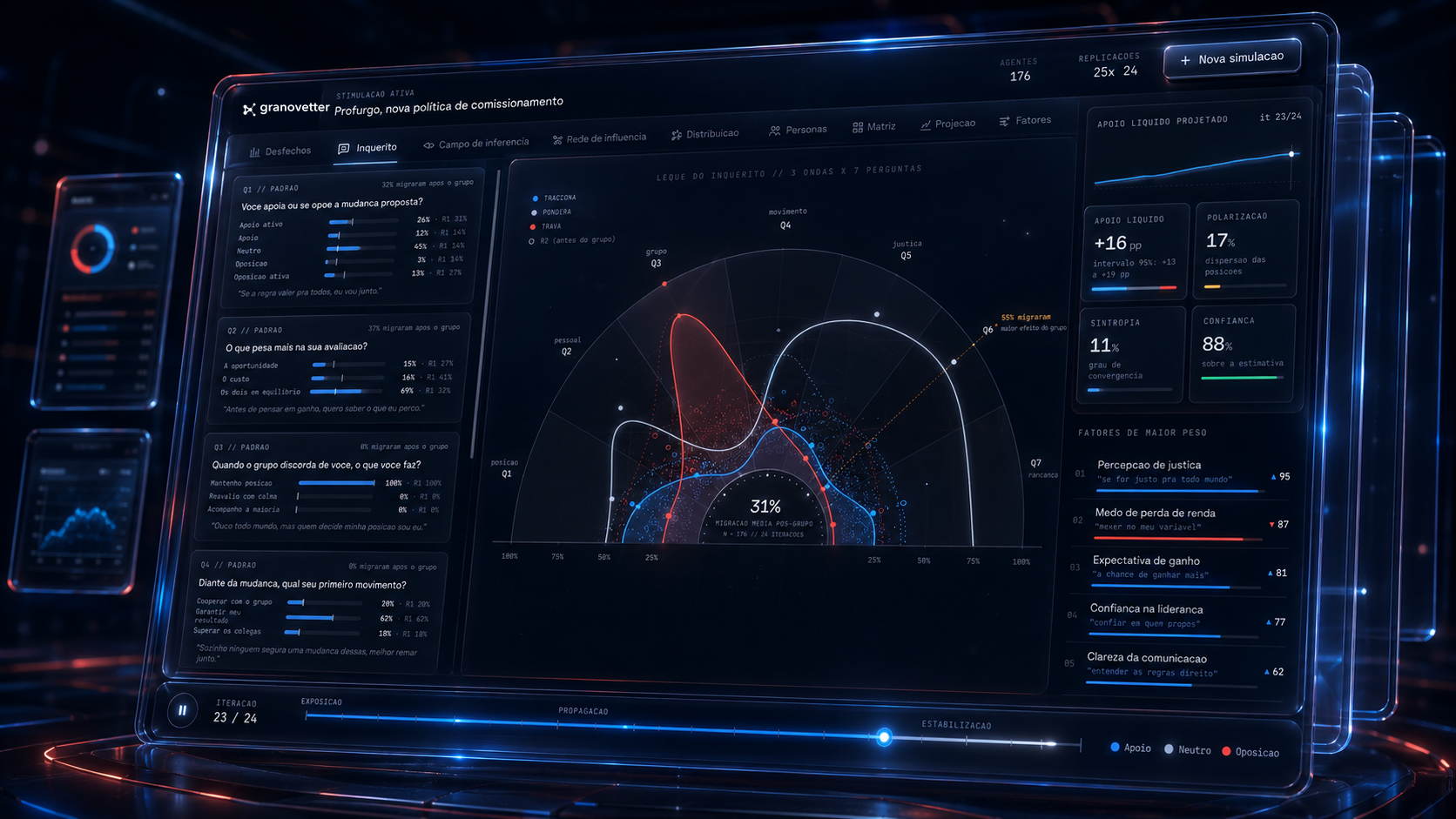
Those agents are then exposed to critical scenarios, decisions and strategic variables. First they respond individually. Then they interact with the collective, adjusting positions, resisting, buying in or amplifying narratives.
The result is not a single prediction. It is a distribution of scenarios, risks and probabilities to support decisions before execution.
Synthetic agents
Representative profiles based on real groups within the organization.
Organizational environment
Culture, external context, leadership, social pressure and where the company stands.
Individual projection
Each agent reacts to the scenario before knowing the group.
Collective interaction
Agents confront each other's answers, narratives and social pressures.
Probabilistic synthesis
The system reveals likely scenarios, emerging risks and decision paths.
Input→Simulation→Output
Granovetter takes in real data from the organization, turns strategic decisions into simulatable scenarios and delivers behavioral inferences to support the decision before execution.
Input
Cultural data, group profiles, organizational context, external environment and the decision to be tested.
Simulation
Synthetic agents interact with scenarios, pressures, narratives and strategic variables.
Output
Likely scenarios, emerging risks, hidden tensions, patterns of buy-in and resistance, and recommendations for the decision.
The engine is open source.
Each synthetic agent represents a real group in the organization, with its own values, risk tolerance and narrative. In round 1, each agent reacts alone. From round 2 on, it is exposed to the group consensus and to opposing views. The analysis measures adoption, resistance, conformism and anxiety, and locates the tipping point.
Simulation is not prediction. It is decision support, and should be validated against the organization's own data.
Example included in the repository, with a fictional organization: moving 350 people to fully remote work, 6 groups, 3 rounds.
Adoption likelihood
62.5%
Junior engineering
85%
Operations
12%
Most likely scenario
Slow adoption with friction (52%)
A tool for deciding better.
We are a small team working at the frontier of multi-agent simulation, behavioral modeling and applied AI to solve the biggest problem in running a company: the lack of predictability.